Fire Door Asset Tagging: What Changes in Your Block
Fire door asset tagging gives each fire door a unique ID, held on a small NFC smart tag fixed to the door and linked to that door’s own record of photographs, components, inspections and repairs. We are fitting the tags to fire doors in the blocks we manage as part of our fire door inspections.
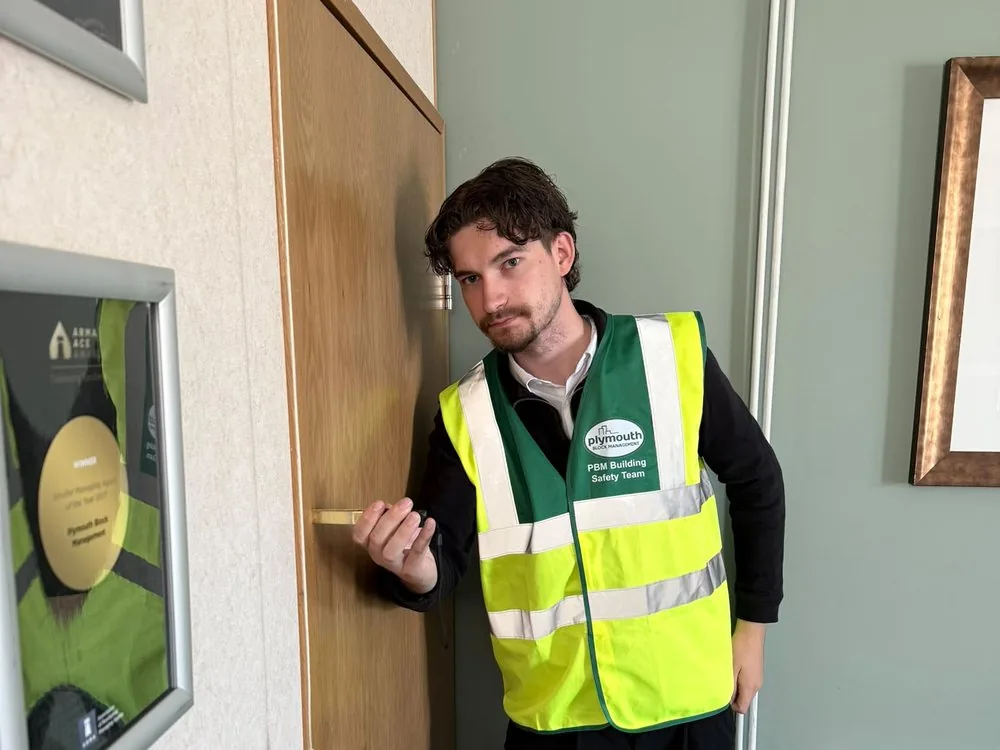
Photo: Plymouth Block Management
In Short
- Over the next few months our Building Safety Team will be visiting buildings we manage to fit small NFC smart tags to their fire doors, communal and flat entrance doors alike.
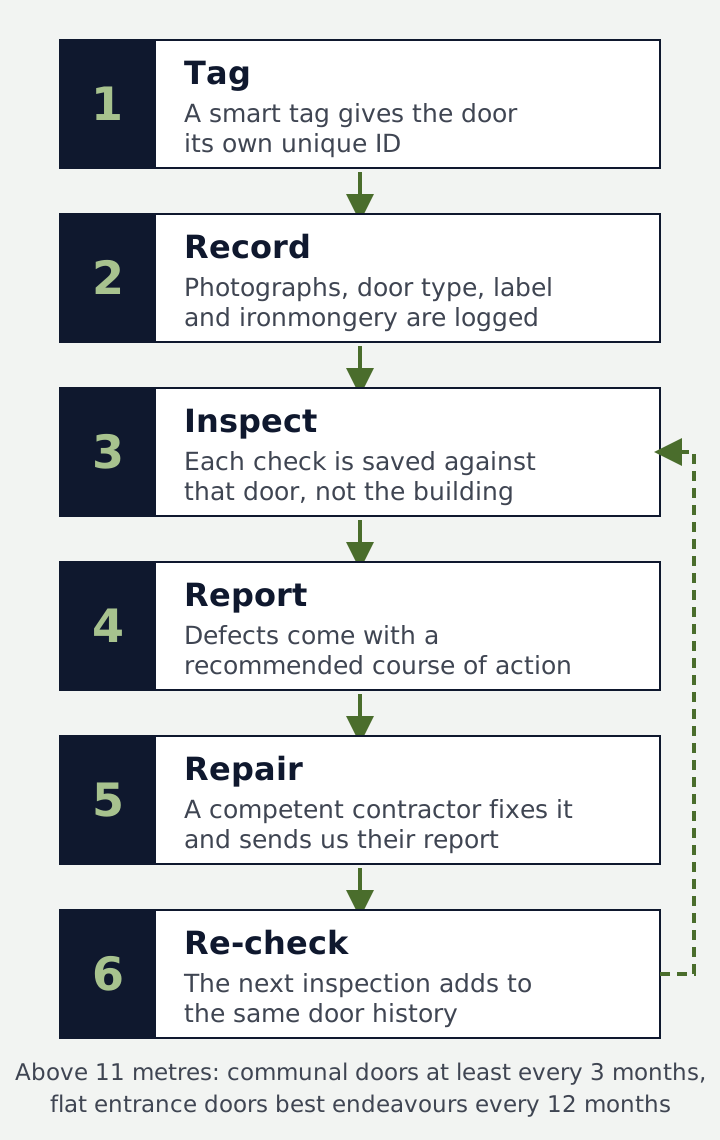
- The tag gives the door a unique ID. When our inspector scans it, the door's own record opens: photographs, door details, ironmongery, inspection history and repairs.
- Doors already in place normally get an adhesive label, so no drilling is needed. Tags set into the door edge are usually fitted when a door is made or installed.
- The tag is not a certification label. Never remove either one, and do not paint over them.
- Where the top storey is above 11 metres, communal fire doors must be checked at least every three months, and best endeavours must be used to check flat entrance doors at least every 12 months, with a record of the steps taken. A tagged record ties every check to the right door.
We are changing how we record fire doors. We are using a system from Door Data Systems, so each fire door we inspect will carry a small smart tag with an embedded NFC chip, the contactless technology used in bank cards and phones, linked to a secure record for that door. Our inspectors will be visiting buildings over the next few months to fit the tags as part of our fire door inspections, and your property manager will confirm whether and when your building is included, and any cost, before we visit. This guide explains what the tag is, what it records, how it fits the law on fire door checks, and what we will ask of residents and directors.
What Is Fire Door Asset Tagging?
Asset tagging gives each fire door an identity of its own. Instead of a line in a spreadsheet that says third floor, flat 12, the door carries a tag, and the tag points to a record that belongs to that door alone. When an inspector scans it, the door's details open on screen and everything recorded on that visit is saved against that door.
Door Data Systems describes its tags as NFC inserts or adhesive labels that link any fire door to its platform. A mobile app is used to scan, record and update the data on site, photographs are uploaded at installation and at any point during an inspection, and the ironmongery, meaning the hinges, closer, latch and other hardware, is itemised in the record.
In practice, every tagged door gets:
- a unique ID that cannot be confused with the door next to it
- a photographic record of the door as it was installed or as we found it
- details of the door, its frame, its ironmongery and any certification label it carries
- a dated history of every inspection, defect and repair
- a benchmarked report, so that doors are assessed in the same way in every building
What Will the Tag Look Like on My Door?
There are two forms of tag, and which one a door gets depends mainly on when it is tagged.
| Insert in the door edge | Adhesive label | |
|---|---|---|
| What it is | A small rigid plug containing the chip, set into the edge of the door | A label containing the chip, fixed to the door |
| When it is usually fitted | When the door is manufactured or installed | When an existing door is surveyed in place |
| Drilling | A small hole in the door edge, usually made by the manufacturer or installer | None |
| What you will see | A small plug on the edge of the door, visible when it is open | A small label on the door |
Our visits over the next few months are to doors that are already in service, so the adhesive label is the usual choice: it avoids drilling into a door that is already hung, and may be certified.
Some manufacturers now fit a Door Data Systems tag at the factory. JELD-WEN, for example, announced in 2024 that it fits a data pin from Door Data Systems to every Certifire doorset it makes. Where a door already has one, it can be linked to the record rather than given a second tag.
Managing a block where this applies? Our team can talk it through with you.
A Smart Tag Is Not a Certification Label
Certified fire doors already carry a mark. BM TRADA explains that a certified door is identified by a label, usually on the top edge, or by plastic plugs in the hanging edge, and that the colour of the plug shows the certification status. The BWF Fire Door Alliance puts the rule plainly: labels should never be removed from the door.
| Certification label or plug | Smart tag | |
|---|---|---|
| Who fits it | The certified company, under its certification scheme | The manufacturer, the installer or our inspector |
| What it tells you | That the door was made under a third-party certification scheme, and by whom | Which door this is, and where its record is held |
| What it carries | A printed number or a coloured plug | An NFC chip linked to the door's record |
| Can it be removed? | No. Removing it loses the evidence that the door is certified | No. Removing it breaks the link to the door's history |
The two work together. Each door is checked against its certification, and photographs of the door, including its certification label where there is one, are kept with its record.
A tag does not make a door compliant. Door Data Systems makes the same point about certification itself: third-party certification alone is not proof of compliance, because a certified door can still be badly fitted or damaged later. What the tag adds is a reliable history of how that particular door has been checked and looked after.
Why Record Fire Doors One by One?
Because the checks and records the law asks for are made door by door. Article 17 of the Regulatory Reform (Fire Safety) Order 2005 requires the fire safety facilities, equipment and devices provided in a building to be kept in an efficient state, in efficient working order and in good repair. The Fire Safety Act 2021 then confirmed that the Order covers the doors between flats and the common parts, which means flat entrance doors.
In a building with two or more flats whose top storey is above 11 metres, regulation 10 of the Fire Safety (England) Regulations 2022 requires communal fire doors to be checked at least every three months and requires best endeavours to check every flat entrance door at least every 12 months. Regulation 10(5) adds a duty to keep a record of the steps taken on the flat entrance doors, including attempts to gain access. Our guide to what regulation 10 requires covers the detail.
| Building | What applies to its fire doors |
|---|---|
| Any block with two or more flats and shared escape routes | Doors kept in efficient working order and good repair (Fire Safety Order, article 17). Residents told to keep fire doors shut, not to tamper with self-closers and to report damage (regulation 10) |
| Top storey above 11 metres | All of the above, plus communal fire doors checked at least every three months and flat entrance doors at least every 12 months on a best endeavours basis, with a record of the steps taken |
| At least 18 metres or seven storeys, with two or more homes | All of the above, plus golden thread information kept digitally under the Building Safety Act 2022 |
Government guidance says the regulation 10 checks are visual, that you should not need a specialist to carry them out, and that you could use electronic means to plan and record them. It also says the checks are not a substitute for periodic assessment of fire doors by fire safety specialists. A tagged record serves both: the routine checks and the detailed inspection land in the same history for the same door. Blocks under 11 metres have their own, lighter set of duties, covered in our guide to buildings under 11 metres.
Does the Golden Thread Apply to My Building?
Only if it is a higher-risk building: at least 18 metres high or at least seven storeys, with at least two residential units. For those buildings, regulation 7 of the Higher-Risk Buildings (Management of Safety Risks etc) (England) Regulations 2023 requires the information to be kept electronically in a form that can be transferred electronically, to be accurate, to be accessible as soon as reasonably practicable, to be secure from unauthorised access, and to be changed only under procedures that record who made the change. Our guide to the golden thread sets out what it contains.
The golden thread regulations do not list fire doors by name. They do require a list of each fire safety management measure and where it is located, and a record of maintenance and repairs to equipment, devices and materials. A door-by-door register is a practical way to hold that information for fire doors, though exactly what a particular building needs is a matter for its accountable person.
Below 18 metres the golden thread is not a legal duty, but the same record answers the questions fire risk assessors, insurers and buyers' solicitors are likely to ask: which fire doors the building has, when each was checked, and what was done about the defects found.
The record also has to outlast whoever keeps it. Dame Judith Hackitt's 2018 review, which set out the golden thread, recommended digital records that are open and non-proprietary. Whatever system a building uses, it is worth knowing how the door records would be handed over if the building ever changed managing agent.
What Happens When We Visit Your Building
- Your property manager will tell you before we visit.
- For flat entrance doors we will contact you to arrange access, because checking the self-closer means opening the door. Where the door is yours under the lease, we will fit the tag with your agreement.
- Our inspector fits the tag, photographs the door and records its details, including any certification label.
- The inspector then inspects the door, recording each finding against that door as they go. Each check is made against the door's certification and the relevant British Standards.
- The inspection report follows within five business days, and every defect comes with a recommended course of action.
- Where your lease makes you responsible for your flat entrance door, you receive the report for your door, with a photograph so you can see it is yours.
Managing a block where this applies? Our team can talk it through with you.
What We Ask of Residents and Directors
- Leave the tag and any certification label in place, and do not paint over either of them.
- Tell us if a tag comes off or is damaged, so we can replace it and keep the door's history linked.
- Give access when we ask. If the time does not suit, tell us and we will rearrange: the law requires a record of the steps taken, including attempts to gain access.
- If you have your flat entrance door repaired, send the contractor's report or certificate to your property manager so the record shows the repair.
- Report damage to any fire door, or a door that no longer closes fully on its own, straight away.
- Directors who want to see the door records for their building can ask their property manager.
If you are choosing someone to repair a door, we cannot recommend a contractor for work to your own flat, but our approved contractor network explains how we vet the contractors we use for the common parts.
Common Questions
The questions residents and directors ask us most about tagging.
Will the Tag Damage My Fire Door?
On doors already in place we normally use an adhesive label, which needs no drilling. The tag sits alongside the door's certification label and never replaces or covers it.
What Is the Difference Between NFC, RFID and QR Fire Door Tags?
All three link a door to its record; the difference is how they are read. NFC is a short-range type of RFID, read by holding a phone or reader close to the chip. A QR code is a printed pattern read by a phone camera, with no chip in it. The tags we fit are NFC tags from Door Data Systems.
Does the Tag Track Me or Hold My Personal Details?
No. The tag identifies the door. NFC tags are passive and are read at close range with a phone or reader. The record they point to describes the door: where it is, photographs of it, its components and its inspection history. Records of access arrangements for your flat are handled under our privacy policy.
My Door Already Has a Coloured Plug in Its Edge. Is That a Tag?
Usually not. A coloured plug in the hanging edge is normally a certification mark from a scheme such as BM TRADA Q-Mark, and it must stay where it is. If a door already carries a Door Data Systems tag from its manufacturer, it can be linked to the record rather than given a second one.
What Happens to the Records If Our Building Changes Managing Agent?
Ask before any handover how the door records will be passed on and in what format. For a higher-risk building, golden thread information must be capable of being transferred electronically. For any building, a door register that moves with the building saves paying for the same survey twice.
Who Do I Contact About Fire Door Tagging?
Your property manager, who can answer questions about the visit and about your building's door records. You can also call the office on 01752 257338.
How We Handle This at PBM
Our fire door inspections are carried out by an ABBE Level 3 qualified inspector from our own team and recorded door by door on the Door Data Systems platform. The scope and the published price per door are on our fire door inspection page.
Plymouth Block Management is an ISO 9001:2015 certified managing agent (certificate FS 685565, audited by BSI) and a member of The Property Ombudsman, providing residential block management across Devon, Cornwall and the wider South West.
Sources
Everything above is taken from these, not from a summary of them:
- Fire Door Technology Door Data Systems
- Installers Door Data Systems
- JELD-WEN supports Golden Thread in data pin doorset launch Specification Online
- The Fire Safety (England) Regulations 2022, regulation 10 legislation.gov.uk
- Fire Safety (England) Regulations 2022: fire doors guidance GOV.UK
- Regulatory Reform (Fire Safety) Order 2005, article 17 legislation.gov.uk
- Fire Safety Act 2021, section 1 legislation.gov.uk
- Keeping information about a higher-risk building: the golden thread GOV.UK
- Higher-Risk Buildings (Management of Safety Risks etc) (England) Regulations 2023, regulation 7 legislation.gov.uk
- Higher-Risk Buildings (Keeping and Provision of Information etc.) (England) Regulations 2024, Schedule 1 legislation.gov.uk
- What is a fire door plug BM TRADA
- Fire door labels: a guide BWF Fire Door Alliance
- Building a Safer Future: final report (Hackitt, 2018) GOV.UK
Spotted something wrong, or something that has moved on? Email move@
Unfamiliar with a term? Our leasehold and block management glossary defines it.
Help with this in your block
Our team provides block management across the South West, including Devon and Cornwall, and can talk you through your options.